

The old design-to-code process had a comforting geography. Design lived over here. Code lived over there. Between them sat a hand-off containing measurements, annotations and the quiet hope that everybody shared the same interpretation of “responsive”.
The new loop is less polite about departmental boundaries.
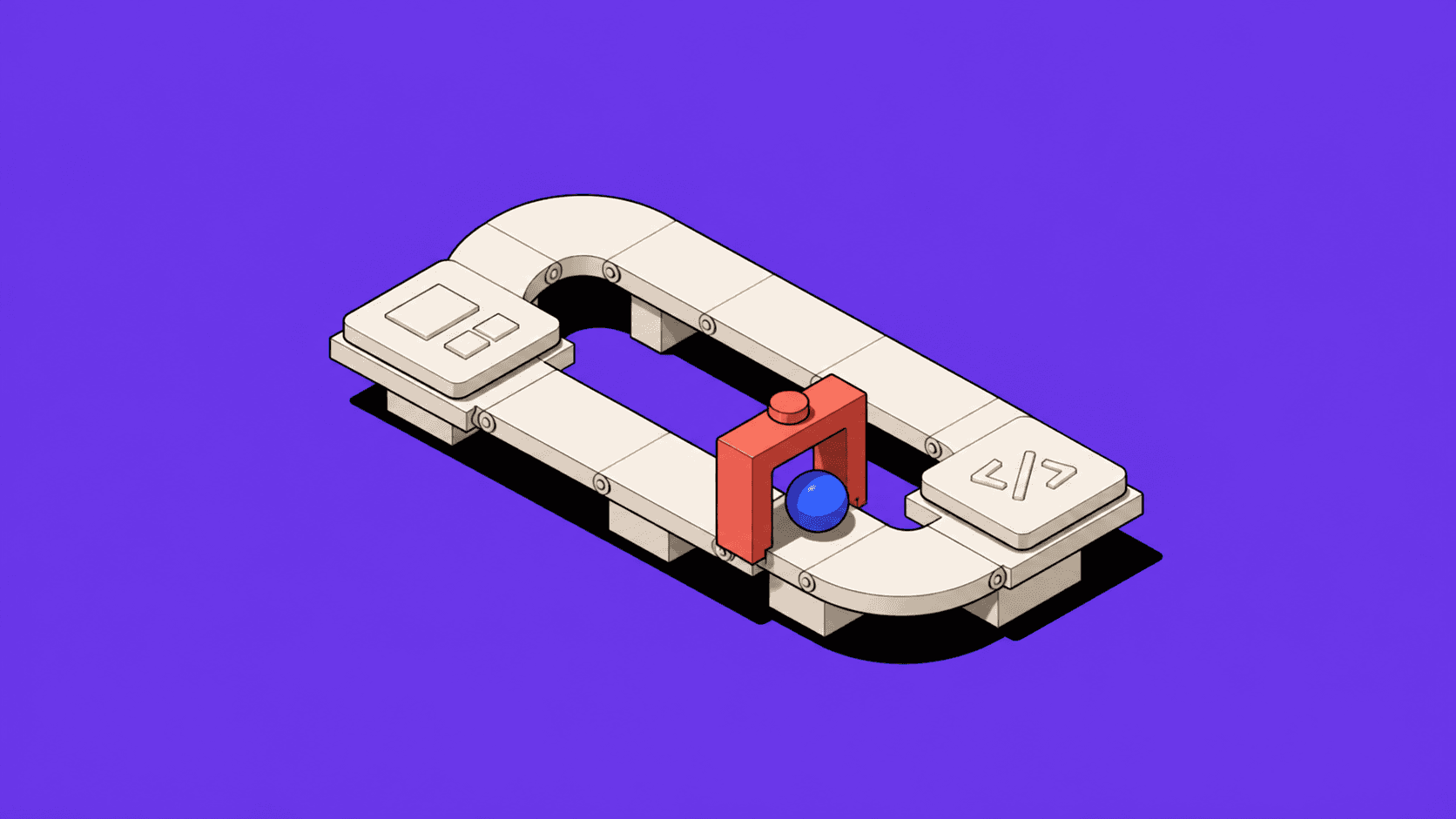
An AI agent can inspect a design, find production components, write code, open the result in a browser, compare it with the intent, repair the implementation and update documentation. A designer can work with real data and component constraints earlier. An engineer can surface implementation changes back into the system. The canvas and codebase begin to behave like different views of one product rather than neighbouring countries with a monthly ferry.
This can make delivery faster. More importantly, it can make standards stronger—if the design system travels through the entire loop.
Hand-off was a symptom of separated truth
Traditional hand-off attempted to transfer decisions from a design representation into an implementation environment.
The process created familiar questions:
Is this spacing intentional or simply where the frame ended?
Does the component already exist?
Which state appears when data is unavailable?
Is the mobile layout designed or expected to emerge through character?
Does the prototype animation describe real behaviour?
Which copy is final?
Documentation helped, but the underlying issue was duplicated truth. Tokens existed in design and code. Components had design variants and production properties. Screenshots described behaviour that tests did not know about.
AI can accelerate translation between these representations. It can also reproduce their disagreement at exceptional speed.
The new loop should therefore reduce translation by connecting sources of truth. The agent needs design intent, production APIs, semantic guidance and live verification—not a larger screenshot and instructions to “match exactly”.
Begin with intent, not pixels
A productive loop starts with the user outcome and workflow state.
Suppose the task is to let a commercial manager review a pricing change before a revised quote is issued. The intent includes:
old and proposed values must be comparable;
the source of each change must be visible;
material changes require an authorised approver;
requesting changes must return work to the correct owner;
issue remains separate from internal approval;
history must record the decision.
These requirements should exist in product and design-system context before the screen is generated. The design can then explore hierarchy and composition without inventing the authority model.
AI is useful here. It can identify relevant workflow patterns, retrieve comparable product examples and generate representative exceptions. It can point out that a generic confirmation modal cannot preserve enough comparison context.
The design begins closer to the product’s actual grammar.
Pull production components into design decisions
The loop becomes stronger when the agent knows which components exist in code.
Instead of drawing a new status pill, it can use the actual `WorkflowStatus` variants. Instead of approximating a diff, it can inspect the production review component and its supported states. Instead of inventing animation, it can apply motion tokens implemented through Motion or another approved foundation.
This does not mean the existing codebase dictates every design. Components embody previous decisions, not eternal law. The design may reveal a missing property, composition or pattern. The difference is that divergence becomes visible and deliberate.
An effective connection exposes:
component name and source;
semantic properties;
supported variants and states;
constraints and accessibility behaviour;
examples from the product;
deprecation information.
The agent can propose extending a component rather than producing a local replica. Designers understand implementation implications earlier. Engineers receive intent expressed through familiar primitives.
Resources such as Great UI, Interface Craft and Design Engineer Tools remain valuable inputs. The loop gives new patterns a route into the product system rather than pasting them directly into a feature like an interesting cutting from another climate.
Generate code with semantic constraints
When the design moves into code, the agent should receive more than geometry.
It needs:
workflow and content rules;
component APIs;
semantic tokens;
permissions;
data shapes;
responsive expectations;
accessibility requirements;
representative states;
acceptance criteria.
This context changes the implementation. A generated-value component uses `source="generated"`, which supplies provenance behaviour. The approval action uses a capability check rather than a locally hidden button. The layout uses system spacing and responsive containers. The change-review pattern includes loading, incomplete and expired states because those were part of the task, not an optional tour after the happy path.
Tools can generate a great deal of code from visual references. The quality difference comes from whether that code participates in the existing product architecture.
AI should also explain material choices: which system pattern it used, where it extended existing behaviour and which assumptions remain. This makes review about decisions rather than a line-by-line attempt to reconstruct intent.
The browser is part of design
The rendered product provides information neither the canvas nor source code can fully supply.
Real fonts wrap. Data varies. Focus moves. Sticky regions collide. Motion feels different when a network request is involved. A responsive breakpoint that looked rational in a frame may create a table with the emotional qualities of a luggage rack.
The new loop uses the browser as an active design surface.
An agent can run the interface with representative data, inspect states and compare behaviour against intent. It can check:
hierarchy at relevant viewport sizes;
keyboard and focus order;
overflow and long content;
loading and failure transitions;
reduced-motion behaviour;
touch targets;
data density;
visual consistency with adjacent product surfaces.
Visual comparison catches drift. Interaction testing catches deeper problems. The agent can repair implementation details and return evidence rather than merely reporting that the build succeeded.
Designers benefit by seeing real constraints earlier. Engineers benefit because review comments describe observable behaviour. The product benefits because browser reality stops being a late-stage ambush.
Testing becomes design-system feedback
Tests are usually described as protection for code. In this loop they also protect design decisions.
A component test can verify that an approval summary requires consequence and evidence. An accessibility test can confirm focus behaviour. A visual test can protect hierarchy across variants. A workflow test can ensure users without authority cannot issue a revised quote.
When a new design requires changing a test, the team must decide whether the previous rule is evolving or the implementation is drifting. That conversation is valuable.
The system should connect patterns to relevant tests. An AI agent selecting a component can see what behaviour is guaranteed. When it extends the component, it updates examples and tests rather than leaving the new variant undocumented.
This makes standards executable. Guidance no longer relies entirely on reviewers remembering every rule while examining a large pull request on Friday afternoon.
Updates need to travel both ways
The old process imagined a one-way journey from design to code. Real products teach the system during implementation.
Perhaps production data reveals that a comparison pattern needs a third state for unavailable values. Perhaps keyboard behaviour requires a different composition. Perhaps an integration constraint changes how progress can be represented.
These discoveries should return to design guidance, examples and components.
AI can help identify the affected artefacts and draft updates. Human owners decide whether the implementation discovery represents a reusable rule. The design system stays aligned because the loop closes.
Without this return path, the design library becomes an increasingly elegant historical document. Code accumulates the actual behaviour, and the next agent receives conflicting instructions.
Speed should reduce rework, not reflection
AI can make every stage faster. Teams may respond by expecting more output rather than a better loop.
The useful measures are not screens generated or code written. They include:
time from intent to verified behaviour;
reduction in duplicated components;
fewer accessibility and responsive defects;
less design rework after implementation;
stronger reuse of workflow patterns;
faster handling of realistic exceptions;
contributions returned to the system.
Speed matters when it removes translation, repetition and preventable correction. Product judgment still deserves time. The loop should make decisions testable sooner, not make decisions unnecessary.
In my design and design-system case studies, the strongest delivery improvements came from connecting understanding to implementation—not simply producing assets faster. Shared patterns reduced repeated debate, while working prototypes exposed questions before they became expensive.
A practical loop
A mature AI-assisted workflow might operate like this:
Frame the outcome. Define user, workflow, consequence and success.
Retrieve system context. Load vocabulary, patterns, tokens, production components and examples.
Explore alternatives. Generate different compositions against explicit criteria.
Choose deliberately. Record why one approach supports the work.
Implement with real components. Extend the system where necessary rather than copying it.
Verify in the browser. Test representative data, roles, devices and exceptions.
Run automated checks. Accessibility, visual, component and workflow tests.
Review product consequence. Confirm evidence, authority, ownership and recovery.
Return learning. Update components, documentation and examples.
AI can participate in every step. Humans retain ownership of the decisions that define the product.
The loop is the advantage
Design-to-code tools will continue improving. High-quality generation will become widely available. The differentiator will not be whether a team can turn a frame into React or produce an animation using Anime.js. It will be whether the resulting software remains coherent, maintainable and grounded in the organisation’s product knowledge.
That advantage lives in the loop.
Intent informs design. The design system supplies reusable judgment. Production components constrain and accelerate implementation. The browser reveals reality. Tests protect behaviour. Learning returns to the system.
The hand-off disappears, but standards do not. They become the material connecting every stage.
Faster delivery is useful. Faster delivery that continuously strengthens the product system is transformative.
